Hollysys Zhejiang University Central Control DCS System OPC AE/ua/da Alarm Data Acquisition Solution
As a professional provider of IoT data acquisition solutions and an expert in industrial IoT data acquisition, the editor of Shanghai Data Acquisition IOT Technology Co., Ltd, (daq-iot) hereby presents the following introduction, and sincerely welcomes discussions and exchanges. Supported Communication Interfaces: CAN, RS485, Mbus, 4–20mA, Profibus, CC-Link, HART, digital I/O, etc. Industrial Protocols: Modbus RTU/TCP, HJ212, IEC104, DLT645, DLMS, IEC61850, MQTT, etc. Mail:export@daq-iot.com
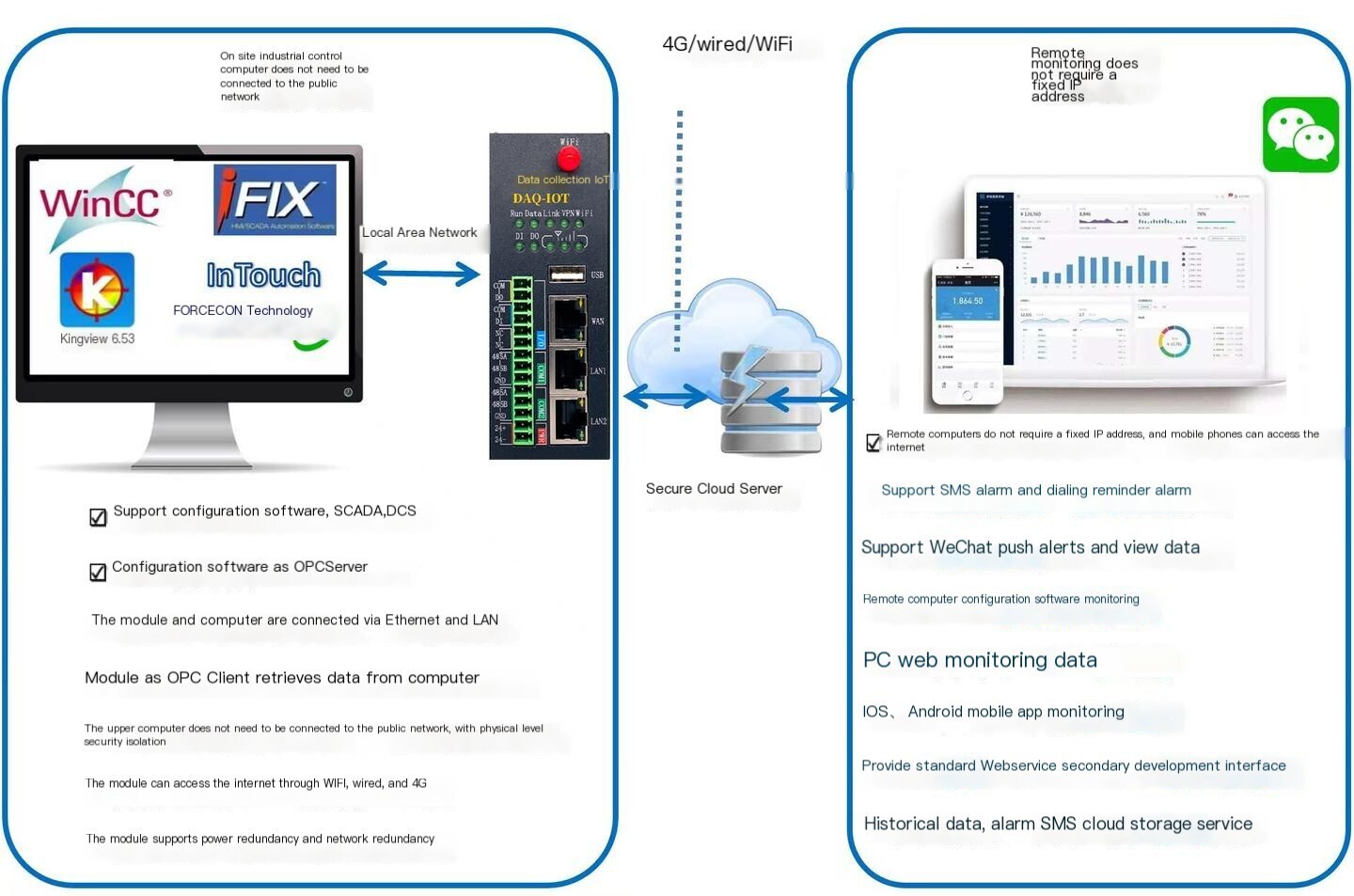
1、 Background and objectives of the plan
1.1 Background
distributed control systemDCS is widely used in process industries such as petrochemicals, power, metallurgy, andSmart Manufacturing. It is the core infrastructure that ensures stable operation of production processes and safe and controllable equipment.alarm systemAs a key component of DCS, Real-time provides feedback on key information such as abnormal process parameters, equipment failures, and system anomalies, which is an important basis for operators to promptly handle risks and avoid production accidents.
OPC AEAs a standard communication in the field of industrial automation, OLE for Process Control Alarm and Events (Protocol) is designed specifically for the transmission of alarm and event data. It enables standardized data exchange between DCS from different manufacturers and third-party systems, solving the problems of incompatibility, data silos, and incomplete data collection in traditional DCS alarms. In order to fully explore the value of DCS alarm data and build a unified alarm management and analysis platform, this OPC AE alarm Data Acquisition scheme is specially formulated.
1.2 Objectives
- Standardized Collection: Based on OPC AE Protocol, it achieves unified collection of DCS alarm and event data from different vendors, breaking down vendor barriers and ensuring standardized data formats and stable transmission.
- Full coverage collection: comprehensively capture various data such as process alarms, equipment alarms, system alarms, and operation events in the DCS system, without omission or delay, ensuring data integrity.
- Data security transmission and storage: Establish encrypted transmission channels to prevent data leakage or tampering; Build a highly reliable data storage system that supports long-term archiving and rapid retrieval of massive alarm data.
- Flexible scalability and compatibility: The solution has good scalability and can adapt to DCS system upgrades, new equipment, and subsequent business needs; Compatible with mainstream OPC AE servers and clients, reducing system integration costs.
- Supporting subsequent applications: Providing high-quality data support for upper level applications such as alarm Data Analytics, fault tracing, process optimization, and equipment predictive maintenance, enhancing the intelligence level of production O&M.
2、 Scope of application and core principles of the plan
2.1 Scope of Application
This solution is applicable to industrial enterprises that use DCS control systems. It meets the Data Acquisition requirements for various alarms (such as high high alarm, high alarm, low alarm, low low alarm, deviation alarm) and events (such as operation records, status switching, system start stop) generated by DCS systems. It can be adapted to DCS systems from mainstream manufacturers such as Siemens, Rockwell, Yokogawa, Honeywell, etc., and supports OPC AE 1.0/1.1 versions Protocol.
2.2 Core Principles
- Stability priority: The collection system needs to operate continuously for 7 × 24 hours, with the ability to self recover from faults and reconnect after disconnection, to avoid affecting the integrity of alarm data due to collection interruptions.
- Security compliance: Following industrial network security standards, measures such as partition isolation, data encryption, and permission control are adopted to ensure the network and data security of DCS systems and collection systems.
- Standardized design: Strictly follow the OPC AE Protocol specification, unify data formats and interface definitions, and ensure seamless integration with upper level alarm management platforms, MES, ERP and other systems.
- Low invasiveness: The collection process does not affect the normal operation of the DCS system, does not occupy too many DCS system resources (CPU, memory, network bandwidth), and avoids interfering with the production control process.
- O&M: The system has complete logging, status monitoring, and fault alarm functions, which facilitateO&Mpersonnel to quickly locate and troubleshoot problems, reducingO&Mcosts.
3、 Core Technology and Architecture Design
3.1 Core Technology Selection
3.1.1 Communication Protocol: OPC AE
OPC AE Protocol is based on Microsoft COM/DCOM technology, designed specifically for the transmission of alarm and event data Real-time. It supports functions such as alarm type classification, event attribute description, and status change notification, and can accurately capture the generation, confirmation, and clearing of alarms in DCS systems full lifecycle data. At the same time, it provides standardized interfaces, without the need to develop customized drivers for DCS from different vendors, greatly improving system compatibility.
3.1.2 Collection mode: Client actively subscribes
Adopting the OPC AE client active subscription mode, after establishing a stable connection with the DCS side OPC AE server, the client subscribes to the required alarm and event data items (such as alarm tags, alarm types, occurrence time, confirmation status, etc.). When the DCS system generates an alarm or event, the OPC AE server actively pushes the data to the client. Compared with the polling mode, it can reduce network bandwidth usage, lower data latency, and ensure Real-time performance.
3.1.3 Data Storage:Time Series Database+Relational database
Based on the characteristics of alarm data, a hybrid storage architecture of "Time Series Database" and relational database is adopted:Time Series Database(such as InfluxDB and TimescaleDB) is used to store massiveReal-timealarm data, which has the advantages of high write performance, low storage cost, and support for time range queries, and is suitable for the high-frequency generation and retrieval of alarm data in the time dimension; Relational databases such as MySQL and PostgreSQL are used to store structured data such as alarm configuration information, device basic information, and user operation logs, ensuring data association queries and transaction consistency.
3.1.4 Network Security: Industrial Firewall+Encryption Transmission
Implement partition isolation between DCS control network and acquisition network through industrial firewall, only open ports required for OPC AE communication (such as port 135 and dynamically allocated ports), and prohibit unrelated network access; Using methods such as DCOM encryption, SSL/TLS encryption, etc., encrypt the data transmission during the collection process to prevent data theft and tampering; Simultaneously set strict account permissions, allowing only authorized personnel to access the collection system and data.
3.2 Overall System Architecture
This scheme adopts a layered architecture design, which is divided from top to bottom into Data Acquisition layer, data transmission layer, data processing and storage layer, monitoring and O&M layer. Each layer is independently deployed and works together to ensure the flexibility of the system and Scalability.
3.2.1 Data Acquisition layer
Located on the DCS control network side, the core components are OPC AE server and acquisition terminal:
- OPC AE Server: Typically provided or deployed by DCS vendors as third-party OPC AE servers (such as KepwareMatrikonOPC)Responsible for collecting alarm and event data from the DCS controller, formatting it according to the OPC AE Protocol specification, and providing a data interface for the collection terminal.
- Collection terminal: Deploy OPC AE client software, establish a connection with OPC AE server, subscribe to target alarm data items, receive alarm and event data pushed by the server, and perform preliminary data verification (such as format verification and integrity verification) to filter invalid data.
3.2.2 Data Transmission Layer
Responsible for data transmission between the collection terminal and the backend processing system, with the core consisting of industrial firewalls, switches, and encrypted transmission channels:
- Network equipment: Build a dedicated collection network through industrial switches to ensure the stability of data transmission; Industrial firewalls implement isolation between control networks and collection networks, configure access control policies, and restrict unauthorized access.
- Transmission channel: encrypted transmission Protocol is used to encrypt the collected data End-to-End, ensuring that the data is not leaked or tampered with during transmission; At the same time, it has a disconnection and reconnection mechanism. When the network is interrupted, the collection terminal automatically caches data, and when the network is restored, data is resent to avoid data loss.
3.2.3 Data Processing and Storage Layer
The core components for processing, converting, and storing collected alarm data include a data processing engine Time Series Database、 Relational database:
- Data processing engine: Clean the collected raw alarm data (filter invalid data, remove duplicate data), convert it (unify data format, supplement associated information such as equipment number and process area), enrich it (associate basic equipment information and process parameters), and generate standardized alarm data.
- Time Series Database: Stores processed Real-time alarm data, supports quick queries based on alarm tags, time ranges, alarm types, and other dimensions, meeting the retrieval needs of upper level applications for massive alarm data.
- Relational database: stores structured data such as alarm configuration information (such as alarm threshold, alarm level), device basic information (such as device name, model, location), user operation logs (such as alarm confirmation, clearing records), etc., providing support for data association analysis.
3.2.4 Monitoring and O&M Layer
Responsible for collecting system status monitoring, fault alarms, and O&M management, with core functions including:
- Status monitoring: Real-time monitors the running status of OPC AE servers, collection terminals, databases (such as CPU usage, memory usage, network connection status), as well as the Real-time integrity and completeness indicators of Data Acquisition.
- Fault alarm: When the system encounters abnormalities (such as collection interruption, database failure, network disconnection), notify O&M personnel through sound and light alarms, SMS, email, etc., and record the details of the fault for quick troubleshooting.
- O&M Management: Provides functions such as data backup and recovery, configuration management, and log management, supporting O&M personnel to remotely maintain the system, modify collection configurations, view operational logs, and backup historical data.


评论
发表评论