How to achieve precise online monitoring of dust particles in clean rooms of electronic/pharmaceutical factories?
As a professional provider of IoT data acquisition solutions and an expert in industrial IoT data acquisition, the editor of Shanghai Data Acquisition IOT Technology Co., Ltd, (daq-iot) hereby presents the following introduction, and sincerely welcomes discussions and exchanges. Supported Communication Interfaces: CAN, RS485, Mbus, 4–20mA, Profibus, CC-Link, HART, digital I/O, etc. Industrial Protocols: Modbus RTU/TCP, HJ212, IEC104, DLT645, DLMS, IEC61850, MQTT, etc. Mail:export@daq-iot.com
In industries with extremely high environmental requirements such as electronic chip manufacturing and pharmaceuticals, the concentration of dust particles in clean rooms directly affects product yield and production safety. Traditional manual sampling and detection not only have low efficiency and data lag, but are also susceptible to operational errors that can affect the results. This article will provide a detailed explanation of a setNetwork version high-precision cleanliness monitoring schemeWithout the need for complex wiring, it can achieve 24-hour online collection and data docking of clean room dust particles, providing practical reference for enterprise production environment control.
1、 Core requirements and pain points for cleanroom monitoring
There are strict standards for environmental cleanliness in scenarios such as clean workshops in electronic factories and sterile workshops in pharmaceutical factories (such as ISO14644-1)GMP standards)The traditional management model has many pain points:
1. Low efficiency of manual inspectionRegular handheld sampling devices are required to collect data at various points, which is time-consuming and labor-intensive, and cannot cover the entire monitoring period, resulting in regulatory gaps;
2. Poor data timelinessAfter sampling, it needs to be sent to the laboratory for analysis, but the results are delayed and the problem of particle concentration exceeding the standard cannot be detected in a timely manner;
3. Difficulty in linking dataManually recorded data cannot be directly integrated into the production management system, making it difficult to form visual analysis and traceability;
4. Point deployment is restrictedTraditional wired equipment wiring is cumbersome, and construction in some clean areas is difficult, making it difficult to flexibly expand monitoring points.
In response to the above issues,Online dust particle monitoring deviceIt can achieve automated and intelligent cleanliness control, perfectly adapting to the strict requirements of the electronics and pharmaceutical industries.
2、 Core monitoring equipment and core advantages
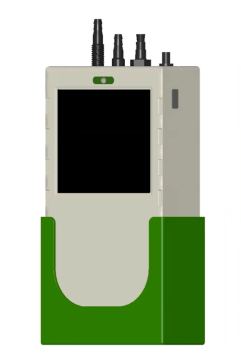
This plan is selectedNetwork version high-precision cleanliness testerDesigned specifically for cleanroom environments, supporting Ethernet/Modbus communication and stable integration with enterprise management platforms, the core advantages are as follows:
1. Multi particle size precise monitoringIt can simultaneously monitor the concentration of multiple particle sizes such as 0.5 μ m and 1.0 μ m. Real-time displays key environmental parameters such as particle count, temperature and humidity, and pressure difference, and the data accuracy meets industry standard requirements;
2. Online continuous monitoringSupport 24-hour uninterrupted collection, replace manual inspection, and achieve full time and full coverage cleanliness monitoring;
3. Convenient communication and dockingUsing Ethernet interface, supportingModbusProtocol, can directly interface with workshop SCADA systemMES systemOr third-party data platforms, to achieve automatic data uploading and centralized management;
4. Industrial grade stable and reliableThe equipment is adapted to clean room environments, has dust-proof and anti-interference capabilities, can operate stably for a long time, and reduces maintenance frequency;
5. Visual data displayEquipped with a high-definition display screen, it can intuitively view Real-time data and historical curves. In case of abnormalities, it can quickly alert through indicator lights and other means, making it easy for on-site personnel to handle in a timely manner.
3、 Core steps for implementing the plan
1. Point planning and deployment
·Based on the clean room area and production area division, determine monitoring points (such as key production workstations, ventilation openings, entrances, etc.) to ensure coverage of core control areas;
·The equipment adopts wall mounted/bracket installation method, which does not require complex wiring and can be directly connected to the workshop LAN through Ethernet cables. It is flexible to deploy and does not affect the airtightness of the clean room.
2. Equipment installation and debugging
·After fixing the device, connect the network cable and power supply, and confirm that the device starts normally;
·Configure device IP addresses and communication parameters to ensure interoperability with the enterprise management platform network;
·Calibrate the sampling flow and counting accuracy of the equipment to ensure that the monitoring data meets industry standards.
·
3. Platform integration and data management
·Connect device data to the enterprise production management system through Modbus Protocol to achieve centralized storage and visual display of data;
·Alarm thresholds can be set for parameters such as particle concentration, temperature and humidity, and pressure difference. In case of abnormalities, an automatic warning will be triggered to notify relevant personnel for timely handling;
·The platform automatically generates historical data reports and trend curves, supporting queries by time and location, providing data support for production environment optimization and compliance auditing.
4、 Implementation value and applicable scenarios of the plan
1. Core values
· Improve production yieldReal-time monitors cleanliness, promptly detects particle exceeding standards, avoids product scrapping due to environmental pollution, and ensures the quality of electronic chips, drugs, and other products;
· Reduce management costsReplacing manual inspection mode, a single manager can remotely control multiple clean areas, greatly saving manpower and time costs;
· Meet compliance requirementsComplete historical data records and traceability enable easy handling of industry certifications and regulatory inspections such as GMP and ISO;
· Optimize production processThrough Data Analytics, identify the causes of cleanliness fluctuations, optimize ventilation, personnel management, and other aspects to improve production efficiency.
2. Applicable scenarios
· Electronic manufacturing industrySemiconductor chip and precision electronic component production workshops, controlling the impact of dust on products;
· Pharmaceutical industryAseptic preparation and raw material production workshop, meeting GMP clean environment requirements;
· Laboratory/Research InstitutionPrecision instrument laboratory and biosafety laboratory ensure the stability of the experimental environment;
· Other clean scenariosPlaces that require environmental cleanliness, such as food processing and optical lens production.
5、 Daily O&M and Precautions
1. periodic calibrationAccording to industry standards, regularly calibrate the flow and accuracy of equipment to ensure accurate and reliable monitoring data;
2. Remote inspectionRemote viewing of device online status and data through the management platform, timely detection of offline devices, data anomalies, and other issues;
3. on-site maintenanceRegularly clean the sampling port and casing of the equipment to avoid dust clogging and affecting sampling accuracy;
4. Compliance ManagementProperly preserve monitoring data and calibration records to meet industry regulatory and audit requirements.
Through this online cleanliness monitoring solution, electronic and pharmaceutical factories can efficiently achieve intelligent control of clean room environments, ensuring product quality and production safety while improving management efficiency. It is a practical choice for the clean industry to achieve digital transformation.


评论
发表评论