Technology of Safety Production Risk Monitoring and Early Warning System for Steel and Aluminum Processing (Deep Well Casting) Enterprises
As a professional provider of IoT data acquisition solutions and an expert in industrial IoT data acquisition, the editor of Shanghai Data Acquisition IOT Technology Co., Ltd, (daq-iot) hereby presents the following introduction, and sincerely welcomes discussions and exchanges. Supported Communication Interfaces: CAN, RS485, Mbus, 4–20mA, Profibus, CC-Link, HART, digital I/O, etc. Industrial Protocols: Modbus RTU/TCP, HJ212, IEC104, DLT645, DLMS, IEC61850, MQTT, etc. Mail:export@daq-iot.com
To effectively improve steel and aluminum processing(Deep well casting)Enterprise safety risk management capability, guiding local construction and application of steel and aluminum processing (deep well casting) enterprisesSafety Production Risk Monitoring and Early Warning System(hereinafter referred to as the monitoring and early warning system), this technical guide is specially formulated.
1、 Architectural design requirements
(1) Overall architecture design requirements
The monitoring and early warning system utilizes devices such asSensorto collect online monitoring and management data of key equipment and facilities in enterprises, relying onGuizhou Province Safety Production Perception NetworkTransport and converge to the corresponding emergency management department. Provincial emergency management departments achieve data interconnection and sharing with the emergency management department through the government external network service bus. The overall system architecture is shown in Figure 1.
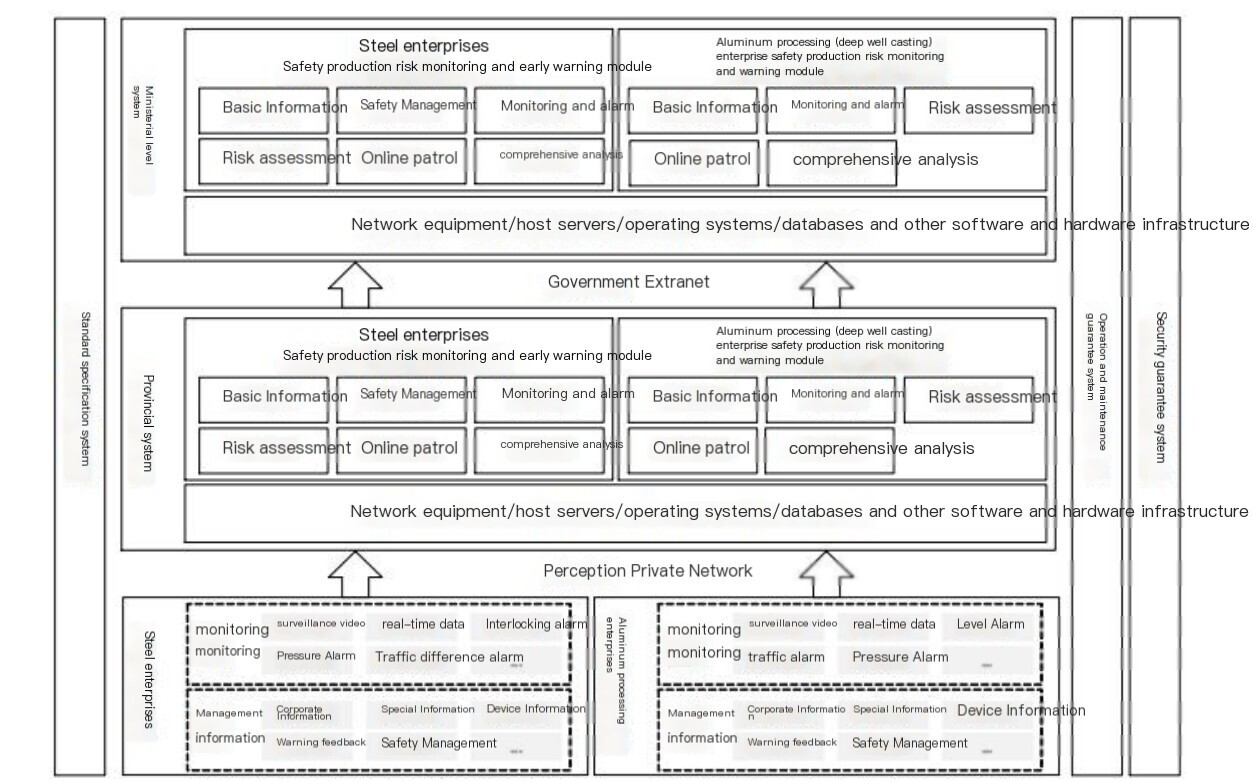
System architecture design requirements
The architecture of the monitoring and early warning system includes infrastructure layer, data layer, application layer, and presentation layer
Layer, standard specification system, O&M guarantee system, security guarantee system,
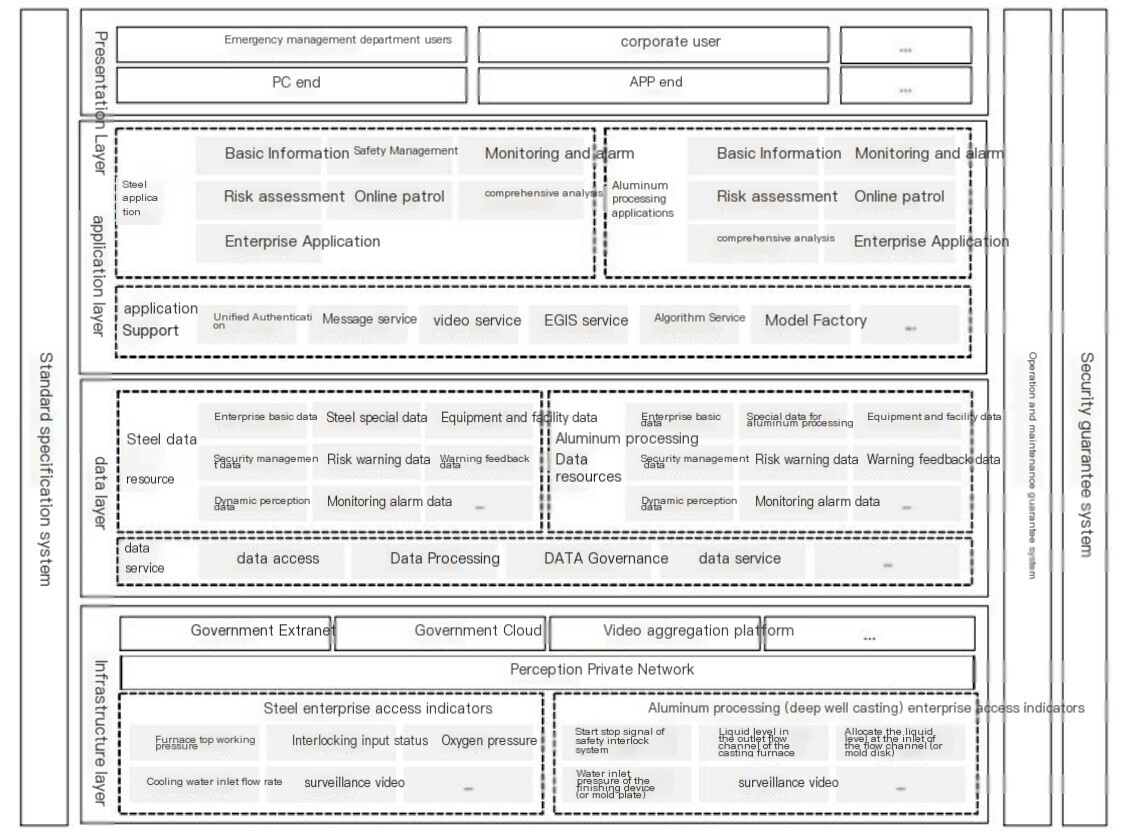
Infrastructure layerIncluding various IoT devices for steel and aluminum processing (deep well casting) enterprises
Network aware devices, video surveillance, access links, and government cloud resources supporting computing and storage
Wait.
Data layer.Including steel data resources, aluminum processing data resources, and data access
Support services. Steel data resources include basic databases of steel enterprises and specialized numbers of steel projects
Database, equipment and facility database, security management database, dynamic perception database, monitoring
Testing alarm database, risk warning database, warning feedback database, etc. Aluminum processing quantity
According to resources including the basic database of aluminum processing (deep well casting) enterprises and the number of aluminum processing special projects
Database, equipment and facility database, security management database, dynamic perception database, monitoring
Testing alarm database, risk warning database, warning feedback database, etc.Application layer.Including supporting applications and business applications.
1. Supporting applications include unified authentication, messaging services, video services, and EGIS services
Public support applications such as business, algorithm services, and model factories.
2. Business applications include steel applications and aluminum processing applications. Steel applications include fundamentals
Information, security management, monitoring and alarm, risk assessment, online inspection, comprehensive analysis
Enterprise applications. Aluminum processing applications include basic information, monitoring and alarm, risk assessment, and
Line inspection, comprehensive analysis, and enterprise application.
Display layer.Including terminal presentation format and service targets. The presentation format of the terminal includes
Computer end, mobile end, etc; The service targets include emergency management department users and enterprise users
Wait.
Standard specification system.Including serving steel and aluminum processing (deep well casting) enterprises
Information maintenance, monitoring and alarm, risk assessment, warning and disposal, as well as services for
Relevant standards and specifications for business collaboration and data sharing between the upper and lower levels of the monitoring and early warning system.
O&M Guarantee system and security guarantee system.Including the protection of monitoring and early warning systems
Obstacles, system O&M management system, and O&M guarantee mechanism, etc., to ensure system security, stability
Efficient and reliable operation.
(3) Requirements for Information Security Architecture Design
On the basis of ensuring the security of the application layer and data layer, the monitoring and early warning system follows the cloud
-Building a basic secure network through edge to edge integration, and deploying itSafety GatewayFire prevention
wall andSecure access GatewayWaiting for security protection equipment, building data security based on wide area network
Full channel, achieving reliable data transmission and system intrusion prevention function, improving overall security.
The enterprise side needs to deploy security Gateway equipment (isolation gateway equipment) to achieve one-way network transmission between the enterprise production network and the security perception network, and to ensure the security of perception data and video data
Upload all. The information security architecture is shown in Figure 3.
Figure 3 Information Security Architecture Diagram
By deploying secure Gateway devices on the enterprise side, the perception data and video count can be monitored
Secure encryption and uploading of data; Deploy firewalls at the central network boundary and implement security measures
Slightly prevent flooding attacks, DDoS attacks, and other attacks from external networks to enhance the system's resistance to attacks; Implementing access to enterprises through the deployment of secure access Gateway in the central network
Authentication of devices (users), integrity authentication and decryption of data reported by enterprises, and submission to the industry
The forwarding function of the service system is further integrated on the basis of traditional security protection
According to encryption and decryption VPN、 Comprehensive security technologies such as identity authentication and secure storage and forwarding,
Build an application-oriented cloud edge integrated security defense system.
2、 System deployment architecture requirements
The system is deployed on a cloud platform to meet the access needs of enterprise perception data and video data,
Meet the daily access needs of emergency management department users and enterprise users. The system meets the requirements of high
To meet the requirements of high security, high performance, and to meet emergency needs through the security protection of firewalls
Requirements for management department users and enterprise users to access the system through the Internet. system deployment
The architecture is shown in Figure 4. The system needs to deploy Real-time data receiving service, static data processing service, and monitoring
Algorithm services, apply for related Big Data storage, file storageMessage QueueWaiting for components,
Support the normal operation of the system.
3、 Functional Design of Safety Production Risk Monitoring and Early Warning Module for Steel Enterprises
Realize the aggregation of basic information for steel enterprises; Realize blast furnace, converter, and refining in steel enterprises
Networking equipment and facilities such as smelting furnaces, electric arc furnaces, and gas systems, as well as monitoring and alarm data access;
Using monitoring and early warning models to achieve risk classification and early warning for steel enterprises, and pushing advance notifications to the enterprises
Police information, receiving and handling results; Support emergency management department users to access steel enterprises online
Patrol. The functional design of the safety production risk monitoring and early warning module for steel enterprises is shown in Figure 5. (1) Requirements for the functional design of the ministerial level system
1. Basic information. Collect basic information and specialized information on steel enterprises nationwide,
Information on more than ten types of equipment and facilities, including blast furnaces, electric arc furnaces, and molten metal tanks, and their classification
Class statistical analysis, providing data query and visualization display.
2. Safety management. Collect inspection records and inspections of equipment and facilities in steel enterprises across the country
/Calibration records, deactivation records, scrap records, automatic identification of overdue inspection, verification/calibration
Provide data query and viewing functions for situations such as near expiry.
3. Monitor alarms. Gathering national steel enterprises' blast furnaces, converters, refining furnaces, and electric arcs
Real-time perception data, video surveillance data, and alarms for key equipment such as furnaces and gas systems
Record, etc. Access to monitoring indicators related to safety risks in national steel enterprises, and
Statistical analysis of line conditions and alarm and suppression situations by region. Having perceptual data and visual capabilities
The Real-time viewing and historical data review functions for 8-frequency monitoring data.
4. Risk assessment. Using the Safety Production Risk Monitoring and Early Warning Model for Steel Enterprises Real-time
Assessing enterprise security risks and achieving risk level data and warning records for steel enterprises nationwide
Collect and display feedback records, and provide risk trend analysis.
5. Online inspection. Summarize the safety risk levels and online status of steel enterprises nationwide
Provide information on device access status, alarm status, warning status, etc., for enterprise spot checks and equipment installation
Implement functions such as backup inspection, video inspection, alarm retrieval, and warning retrieval for steel enterprises
Important information is gathered on one screen.
6. Comprehensive analysis. Including the networking situation and equipment access situation of steel enterprises nationwide
Analysis, Analysis of Enterprise Application Situation, Offline Situation Analysis, Data Quality Analysis, Regular Specialization
Topic report.
(2) Provincial system functional design requirements
1. Basic information. Collect basic information and specialized information on steel enterprises throughout the province,
Information on more than ten types of equipment and facilities, including blast furnaces, electric arc furnaces, and molten metal tanks, and their classification
Class statistical analysis, providing data query and visualization display.
2. Safety management. Collect inspection records and inspections of equipment and facilities in steel enterprises across the province
/Calibration records, deactivation records, scrap records, automatic identification of overdue inspection, verification/calibration
Provide data query and viewing functions for situations such as near expiry.
3. Monitor alarms. Gathering blast furnaces, converters, refining furnaces, and electric arcs from steel enterprises across the province
Real-time perception data, video surveillance data, and alarms for key equipment such as furnaces and gas systems
Record, etc. The access status of safety risk related monitoring indicators for steel enterprises in the province
Statistical analysis of line conditions and alarm and suppression situations by region.
9-4. Risk assessment. Using the Safety Production Risk Monitoring and Early Warning Model for Steel Enterprises Real-time
Assess the security risks of enterprises throughout the province, provide graded warnings for enterprise risks, and push warning letters
Provide information to enterprises to achieve risk level, warning records, and feedback records for steel enterprises in the province
Collect and present, and provide risk trend analysis.
5. Online inspection. Summarize the safety risk levels and online status of steel enterprises in the province
Provide information on device access status, alarm status, warning status, etc., for enterprise spot checks and equipment installation
Implement functions such as backup inspection, video inspection, alarm retrieval, and warning retrieval for steel enterprises
Information is gathered on a single screen.
6. Comprehensive analysis. Including the networking situation and equipment access situation of steel enterprises in the whole province
Analysis, Analysis of Enterprise Application Situation, Offline Situation Analysis, Data Quality Analysis, Regular Specialization
Topic report.
(3) Enterprise functional design requirements
1. Equipment monitoring. Realize blast furnaces, converters, refining furnaces, electric arc furnaces and
Display of key operating parameters of the gas system Real-time and reminder of abnormal indicators.
2. Video surveillance. Realize the access and history of Real-time for networked monitoring videos of steel enterprises
Replay.
3. Alarm records. Realize the unified collection and exhibition of historical alarm records of steel enterprises
Show.
4. Risk warning. Real-time Receive risk warning reminder information and provide warning and disposal measures
Feed channel, supporting query of warning history records.
5. Daily management. Provide management of inspection and calibration records for steel enterprises
Entrance, realizing point inspection and inspection/calibration history query, point inspection overdue reminder, inspection
-10- Reminder of overdue verification/calibration.
6. Information maintenance. Realize basic information of steel enterprises, special information of steel, and steel
Configuration of basic information such as equipment and facility information, monitoring indicator information, and monitoring video information
Management, as well as enterprise shutdown management, equipment and facility shutdown and scrapping management.
4、 Monitoring and early warning module for safety production risks in aluminum processing (deep well casting) enterprises
Can design
Realize the aggregation of basic information for aluminum processing (deep well casting) enterprises; Implement casting system
Networking equipment facilities and monitoring alarm data access; Utilizing monitoring and warning models to achieve aluminum
Classification warning of safety risks for processing (deep well casting) enterprises, and push warning information to enterprises,
Receive disposal results; Support emergency management department users to support aluminum processing (deep well casting) enterprises
Business online inspection. Monitoring and early warning model for safety production risks in aluminum processing (deep well casting) enterprises
The block function design is shown in Figure 6.
Figure 6 Function diagram of safety production risk monitoring and early warning module for aluminum processing (deep well casting) enterprises
(1) Functional design requirements for ministerial level systems
-11-1. Basic information. Collect basic information of national aluminum processing (deep well casting) enterprises
Aluminum processing special information, casting well equipment and facility information, steel wire rope inspection reminder/replacement
Record and conduct classified statistical analysis, provide data query and visualization display.
2. Monitor alarms. Gathering national aluminum processing (deep well casting) enterprises for casting wells Real-time
Perception data, video surveillance data, alarm records, etc. National Aluminum Processing (Deep Well Casting)
Access status, online status, and alarm resolution of monitoring indicators related to enterprise security risks
Statistical analysis of police situations by region. Real time with perception data and video surveillance data
Time viewing and historical data review functions.
3. Risk assessment. Risk monitoring of safety production in aluminum processing (deep well casting) enterprises
Testing and warning model Real-time to assess enterprise safety risks and achieve nationwide aluminum processing (deep well casting)
Collect and display enterprise risk levels, warning records, and feedback records, and provide them
Risk trend analysis.
4. Online inspection. Summarize the safety risks of aluminum processing (deep well casting) enterprises nationwide
Level, online status, device access status, alarm status, warning status, and other information are provided
Supply includes enterprise spot checks, casting well inspections, video inspections, alarm retrieval, and warning retrieval
Implement the function of "one screen aggregation" of enterprise information.
5. Comprehensive analysis. Including the networking situation of national aluminum processing (deep well casting) enterprises and
Equipment access analysis, enterprise application analysis, offline situation analysis, data quality
Quantitative analysis and regular thematic reports.
(2) Provincial system functional design requirements
1. Basic information. Collect basic information of aluminum processing (deep well casting) enterprises in the province
Aluminum processing special information, casting well equipment and facility information, steel wire rope inspection reminder/replacement
Record and conduct classified statistical analysis, provide data query and visualization display.
2. Monitor alarms. Gathering aluminum processing (deep well casting) enterprises in the province for casting wells Real-time
Perception data, video surveillance data, alarm records, etc. Aluminum Processing in the Province (Deep Well Casting)
Access status, online status, and alarm resolution of monitoring indicators related to enterprise security risks
Statistical analysis of police situations by region. Real time with perception data and video surveillance data
Time viewing and historical data review functions.
3. Risk assessment. Risk monitoring of safety production in aluminum processing (deep well casting) enterprises
TheReal-timewarning model is used to assess enterprise security risks, and to provide graded warnings for enterprise risks
Push warning information to enterprises to achieve risk assessment of aluminum processing (deep well casting) enterprises in the province
Collect and display levels, warning records, feedback records, and provide risk trend analysis.
4. Online inspection. Summarize the safety risks of aluminum processing (deep well casting) enterprises in the province
Level, online status, device access status, alarm status, warning status, and other information are provided
Supply includes enterprise spot checks, casting well inspections, video inspections, alarm retrieval, and warning retrieval
Implement the function of "one screen aggregation" of enterprise information.
5. Comprehensive analysis. Including the networking situation of aluminum processing (deep well casting) enterprises in the province and
Equipment access analysis, enterprise application analysis, offline situation analysis, data quality
Quantitative analysis and regular thematic reports.
(3) Enterprise functional design requirements
1. Equipment monitoring. Realize the key operation of casting wells in aluminum processing (deep well casting) enterprises
Display of parameter Real-time and alert of abnormal indicators.
2. Video surveillance. Realize the networked monitoring video of aluminum processing (deep well casting) enterprises
Real-time access, historical replay.
-13-3. Alarm records. Realize the historical alarm record of aluminum processing (deep well casting) enterprises
Unified collection and display.
4. Risk warning. Real-time Receive risk warning reminder information and provide warning and disposal measures
Feed channel, supporting query of warning history records.
5. Daily management. Provide steel wire rope inspection and updates for aluminum processing (deep well casting) enterprises
Change the record management portal to provide overdue reminders for wire rope inspections and updates for wire rope inspections
Change historical record query.
6. Information maintenance. Basic information of aluminum processing (deep well casting) enterprises and aluminum processing
Basic information such as special project information, casting well information, monitoring indicator information, monitoring video information, etc
Information configuration management, as well as enterprise shutdown management and equipment and facility shutdown management functions.
5、 General technical requirements for the system
The monitoring and early warning system should comply with the relevant standards and specifications formulated by the Emergency Management Department
The system should have high security, reliability, and good compatibility. The system should meet the requirements of
The following requirements:
1. It has fault tolerance, disaster recovery, and backup mechanisms, with an average failure time of less than 7 days per year,
The average time for fault recovery is less than 1 hour.
2. The maximum number of concurrent users in the system shall not be less than 10% of the total number of users.
3. Equipped with network transmission and data storage encryption mechanisms, in compliance with security level protection requirements
Please ensure the security of enterprise data and network


评论
发表评论